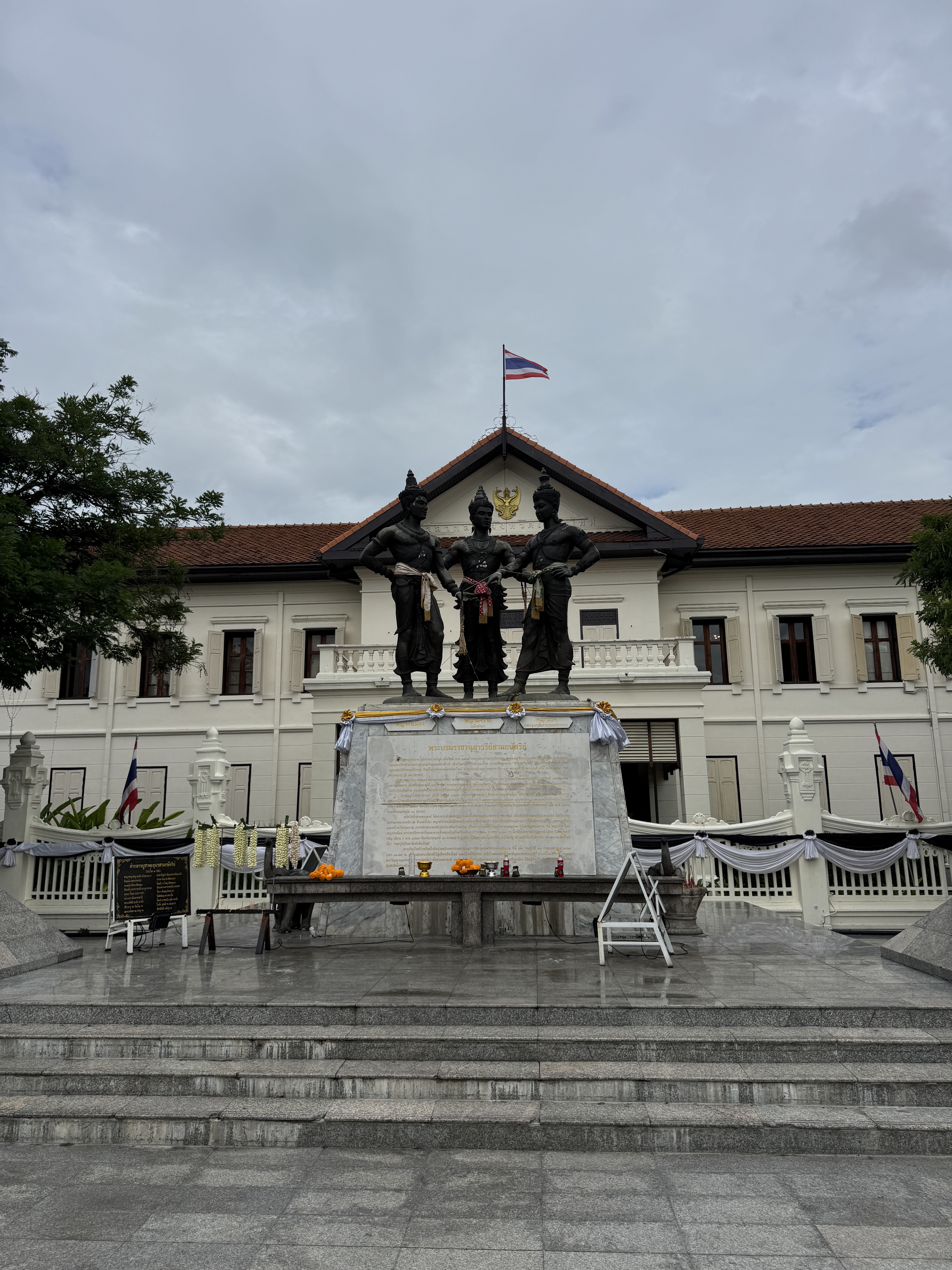
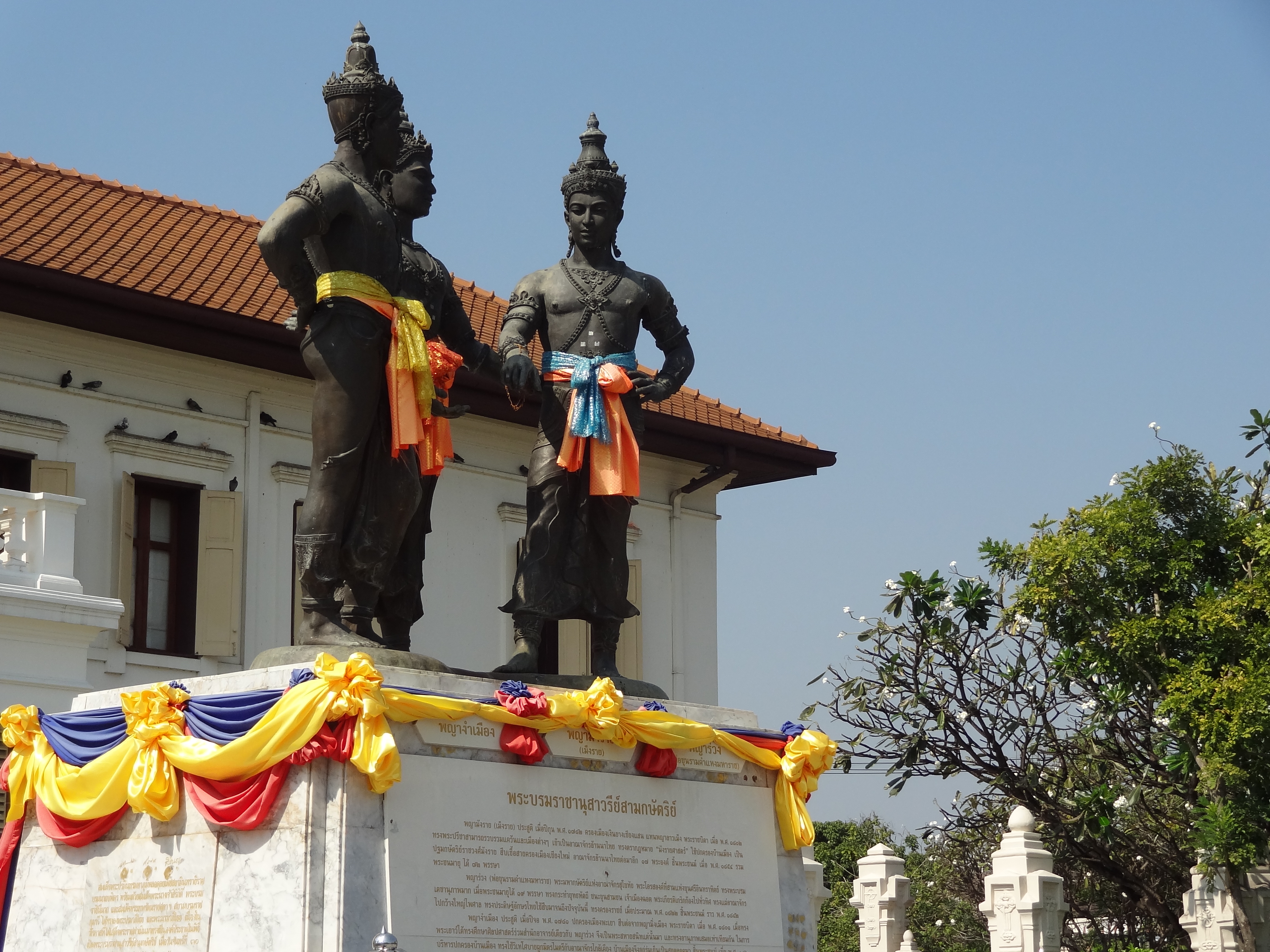
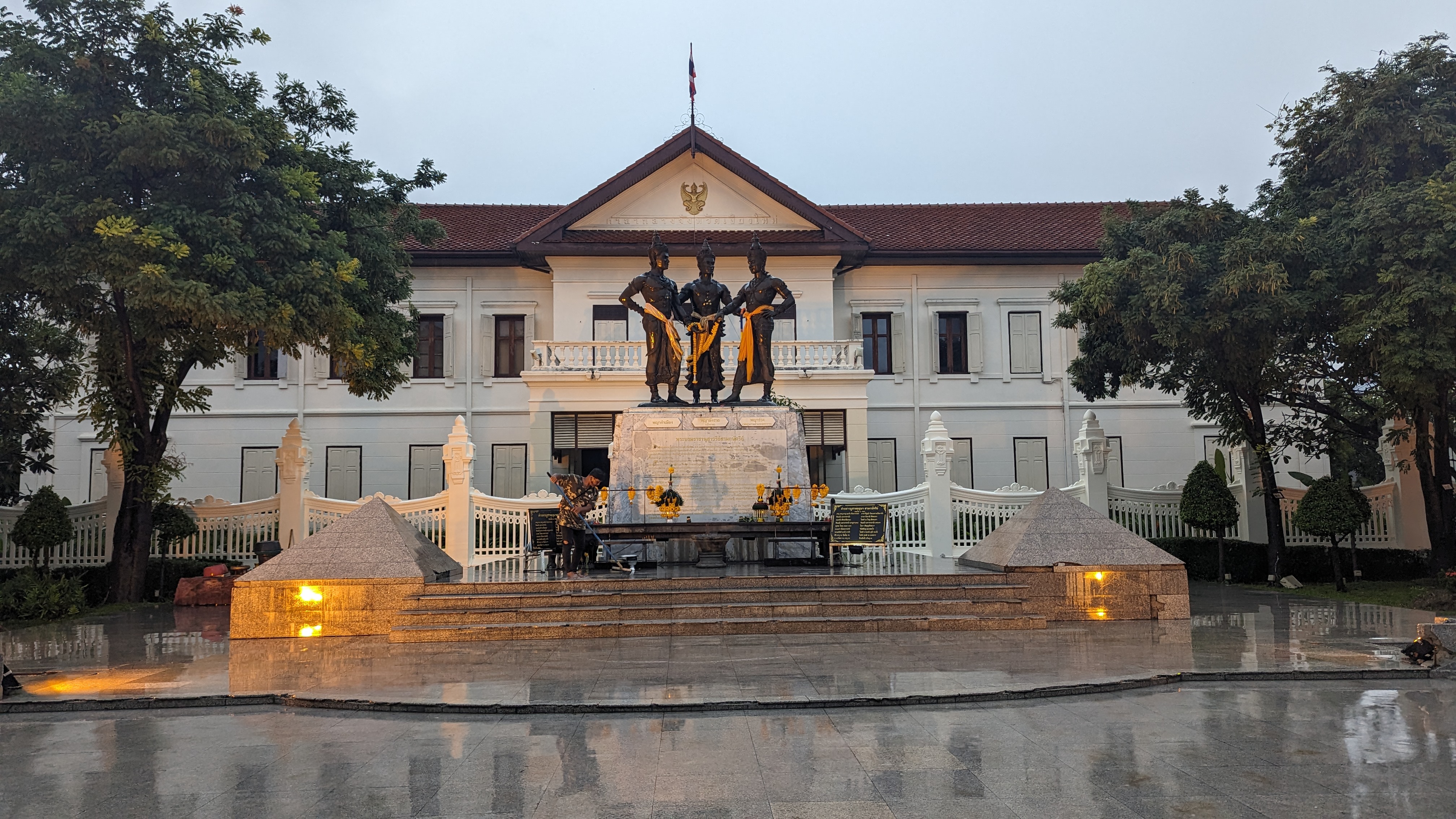
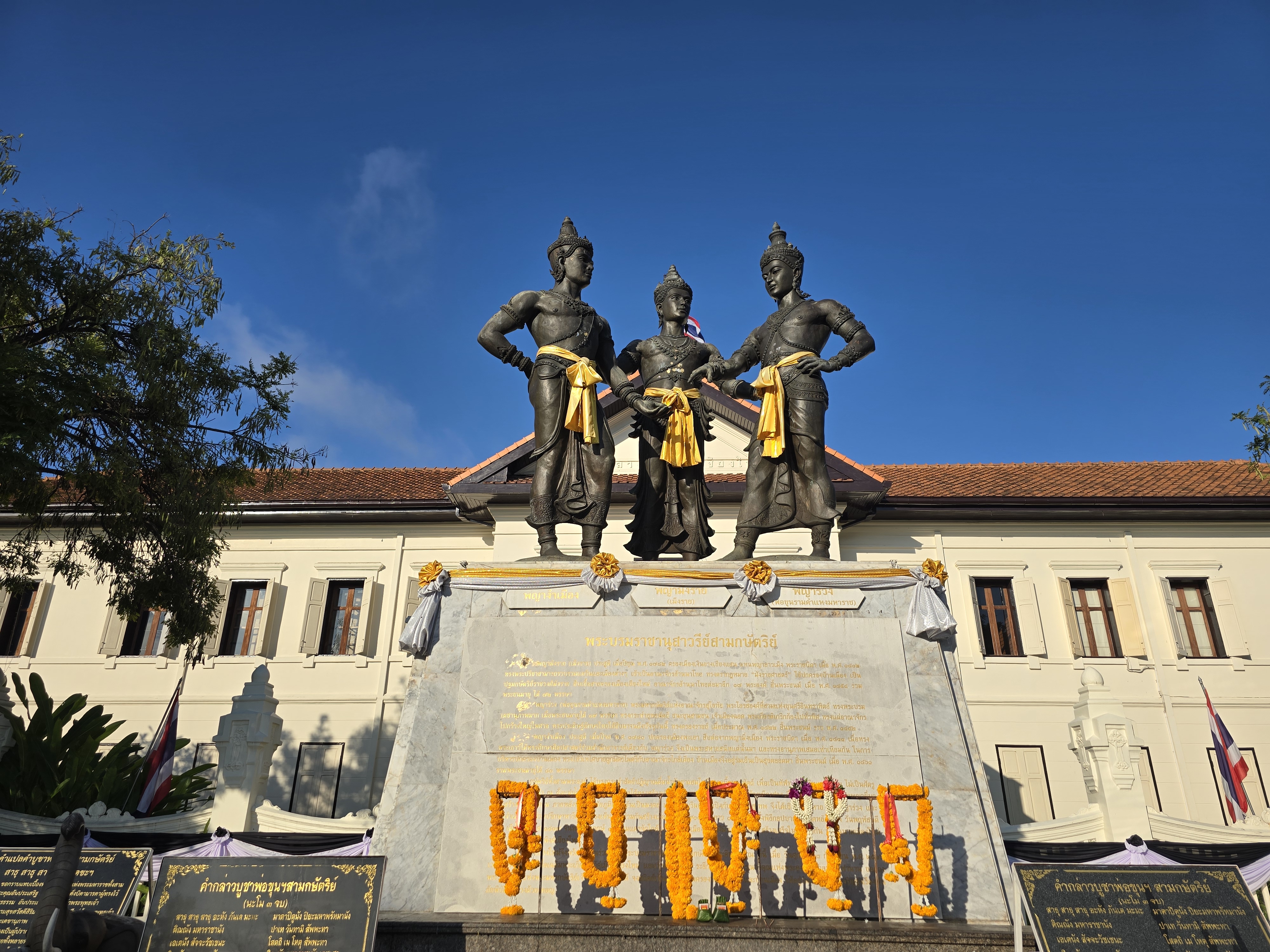
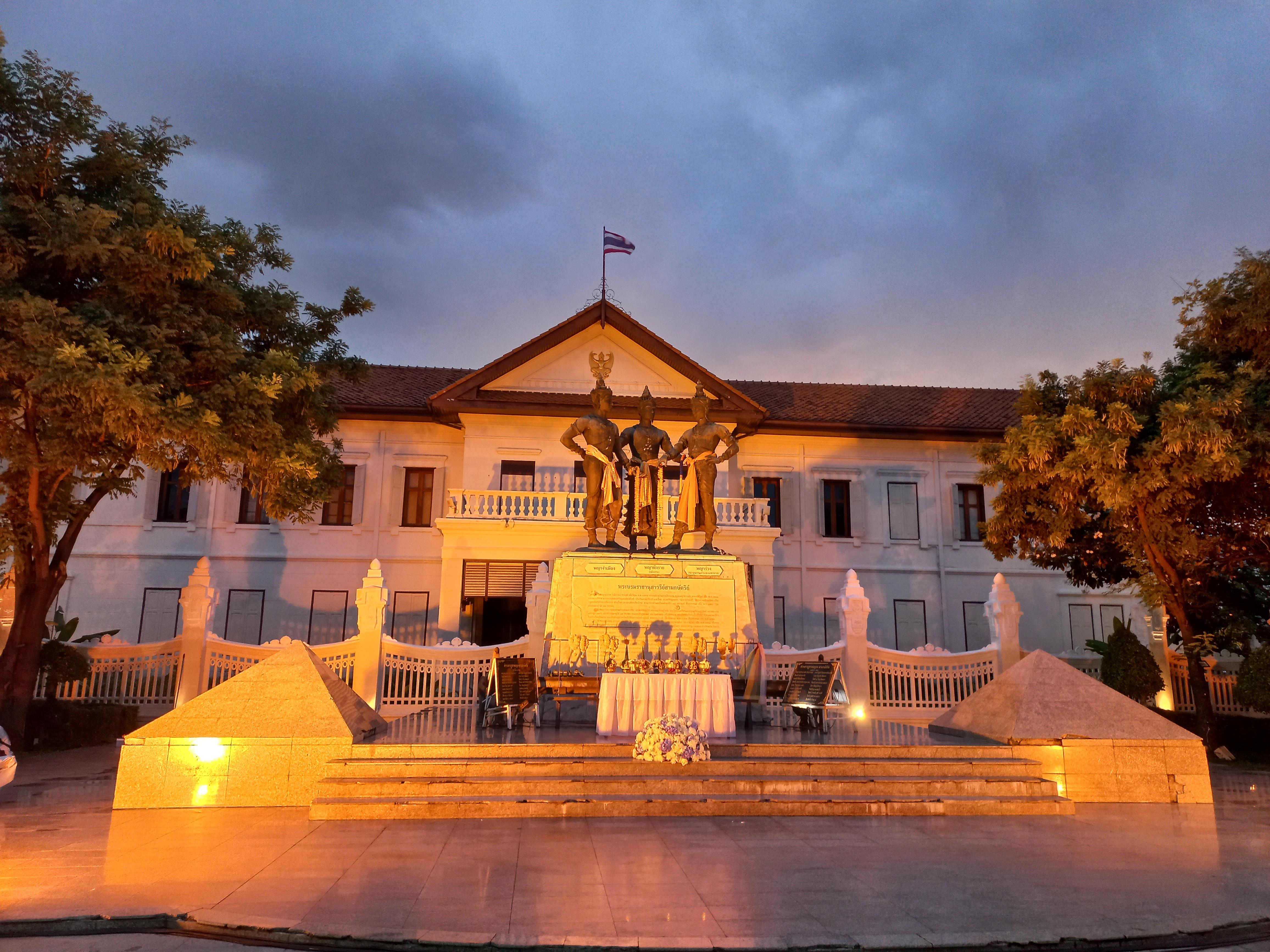
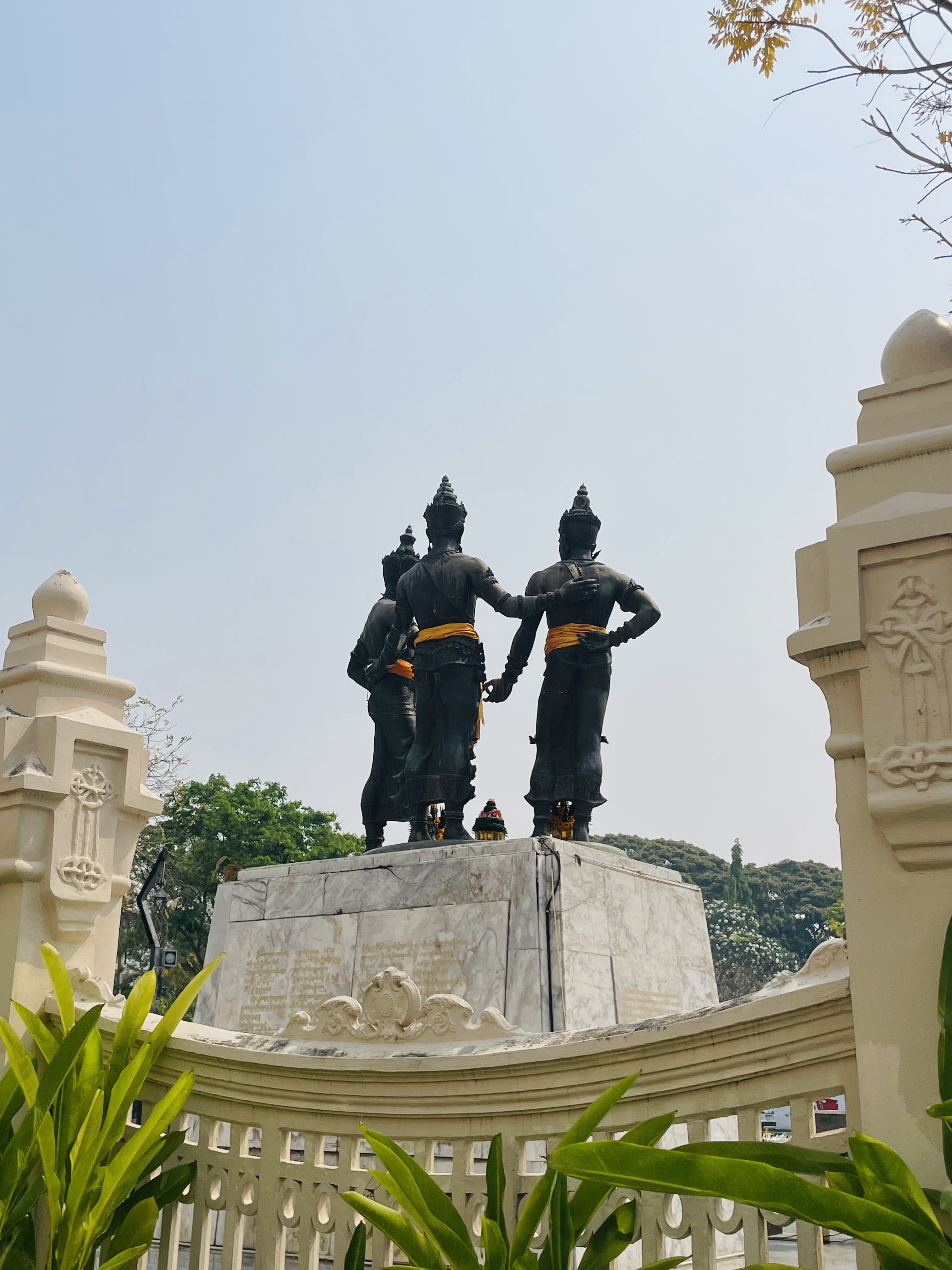
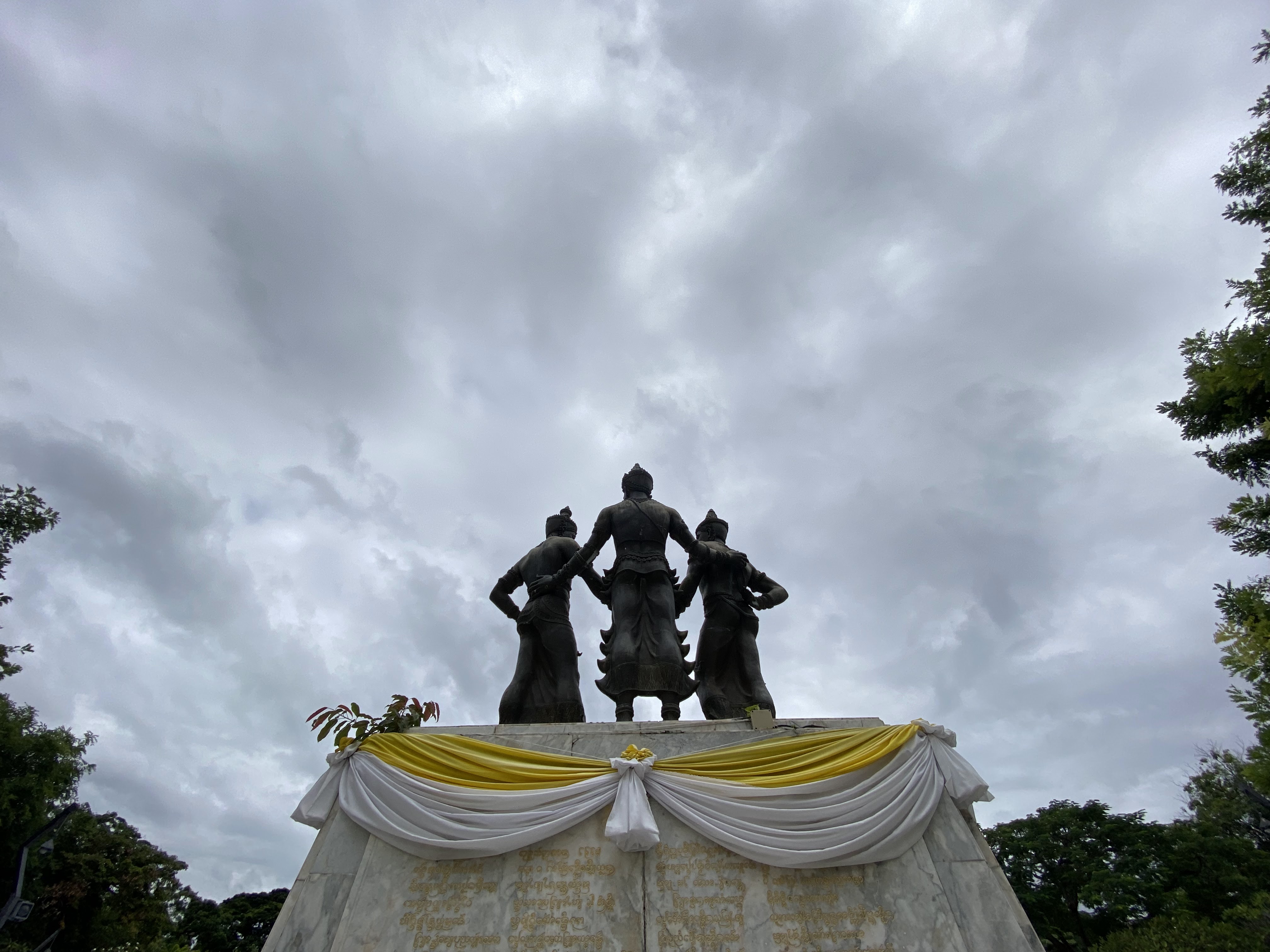
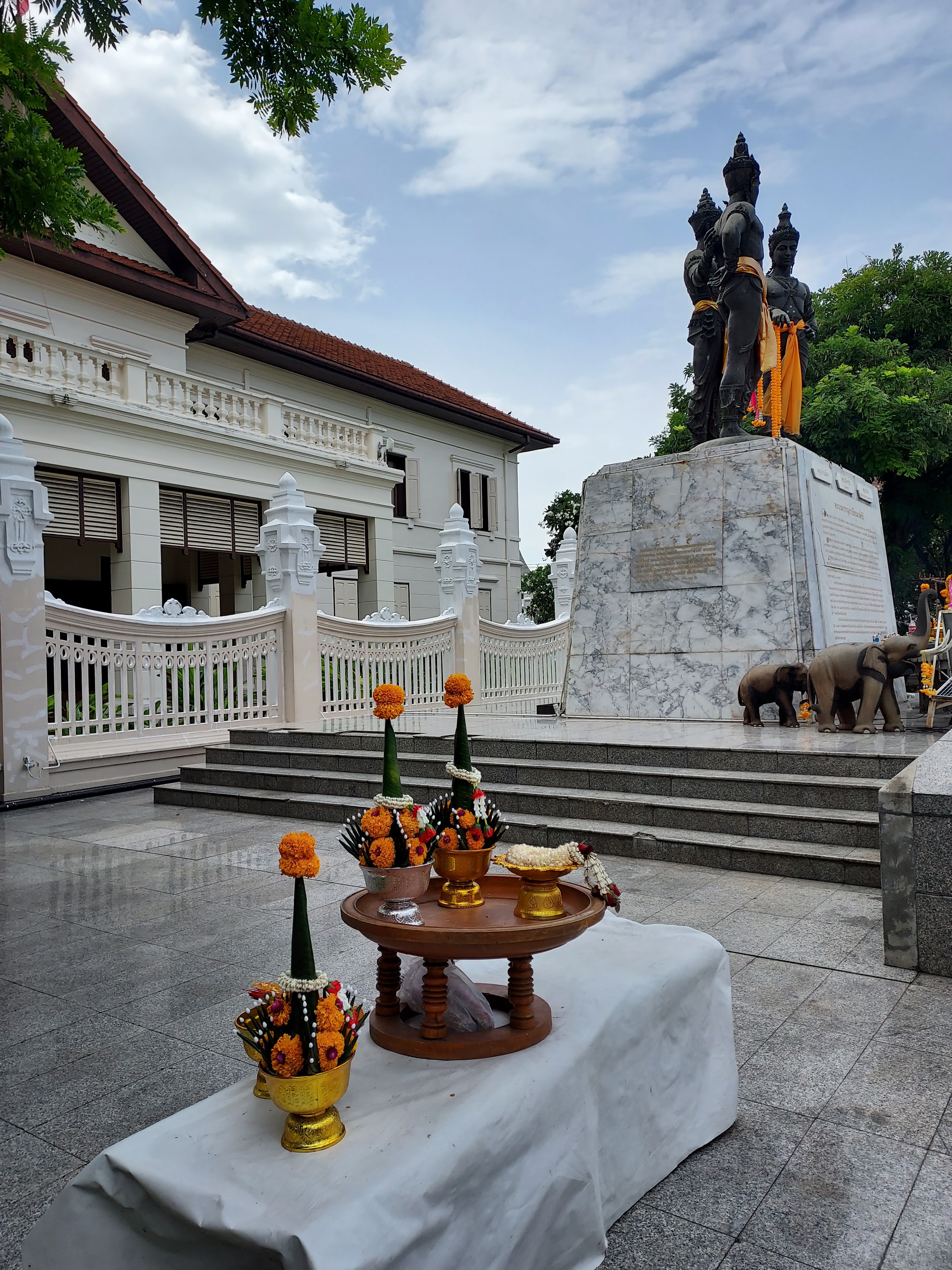
This bronze monument commemorates the three great kings — King Mengrai, King Ramkhamhaeng and King Ngam Muang — who founded the city of Chiang Mai together in 1296.
A landmark at the heart of Chiang Mai's old city, honouring a great friendship and alliance in Lanna history.
Welcome to the Three Kings Monument (พระบรมราชานุสาวรีย์สามกษัตริย์), widely recognized as the central monument of Chiang Mai's old city. Located in the heart of Chiang Mai, Chiang Mai Province, Thailand, this destination serves as a primary hub for travellers visiting the region.
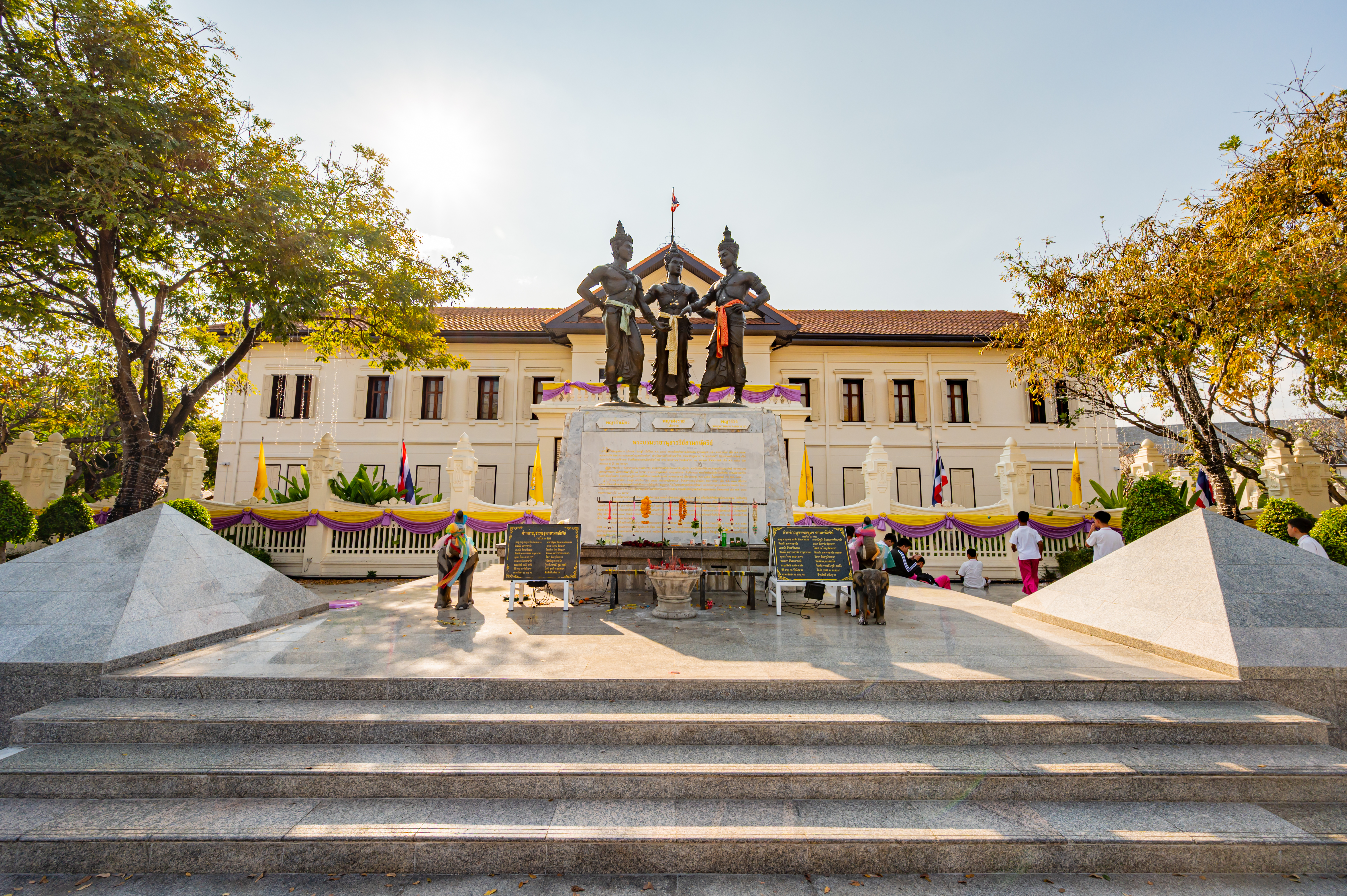
The Three Kings Monument stands in an open square inside the old city walls, in front of the Chiang Mai City Arts & Cultural Centre (the former Provincial Hall). The square sits near the northern end of the famous Sunday Walking Street, which runs along Ratchadamnoen Road from Tha Phae Gate toward Wat Phra Singh — a must-see for every visitor.
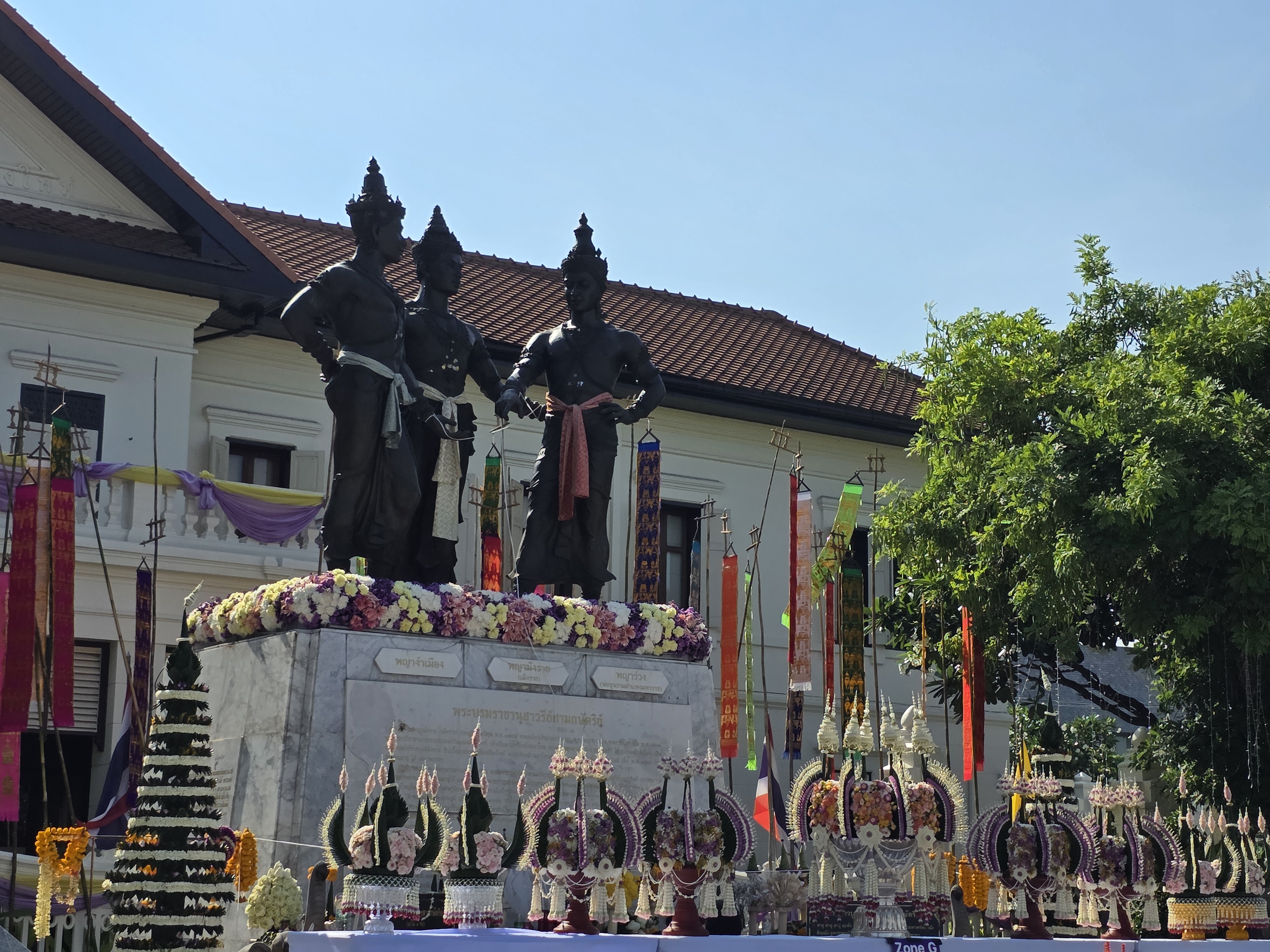
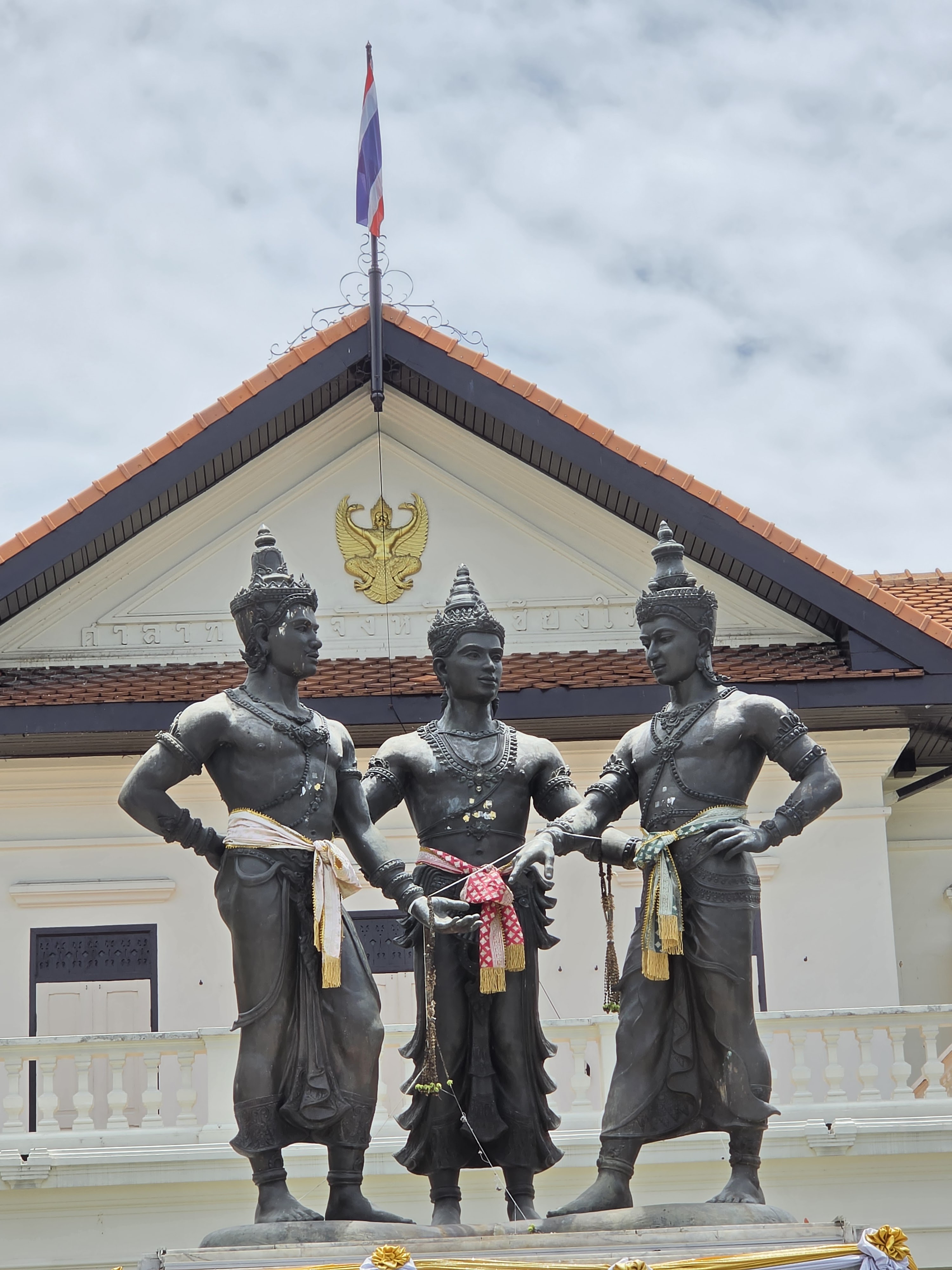
The three bronze statues depict King Mengrai, founder of Chiang Mai; King Ramkhamhaeng the Great of Sukhothai; and King Ngam Muang of Phayao. Legend has it the three kings were close friends and allies who founded Chiang Mai together in 1296.
“The three kings who founded Chiang Mai remind us of friendship, unity and the wisdom of governance.”
24 hours
Open all day
1296
Year Chiang Mai was founded
3 Kings
Figures in the monument
01
Bronze Sculpture
Finely cast bronze statues of the three kings
02
Open City Square
A public square for rest and gatherings
03
Next to Cultural Centre
Adjacent to the Chiang Mai City Arts & Cultural Centre
Editor's Tip
Visit in the early morning or at dusk for the best light and to avoid the crowds.
The bronze is only the surface. Behind it sit a founding alliance, a quarrel settled by a third king, a sacred white elephant and seven centuries of city identity — part recorded history, part legend, and it matters which is which.
Recorded history
Late 13th century
A friendship sealed before there was a city
Lanna chronicles present King Mengrai of the rising northern Tai kingdom, King Ramkhamhaeng of Sukhothai and King Ngam Muang of Phayao as contemporaries who bound themselves to a mutual non-aggression pact. The alliance mattered strategically: with Sukhothai and Phayao as friends rather than rivals, Mengrai could consolidate the north without fighting on three fronts. In 1296 he founded Chiang Mai — literally the new city — on the plain between the Ping River and the mountain, and the three-way understanding became part of how the city explained its own peaceful beginnings.
Legend / traditional account
Traditional account
The quarrel, and the third king who judged it
The best-known story of the three kings is not about founding a city but about a dispute. In the traditional telling, a young nobleman was found in the private quarters of Ngam Muang's queen. Mengrai had him executed without consulting his ally, and Ngam Muang — whose own teacher had also died in the affair — raised his army in anger. Ramkhamhaeng rode between them and brokered a settlement that restored the friendship. The episode is retold in the Chiang Mai chronicle tradition as the moment the alliance was tested and repaired. Historians treat the details as literary rather than documentary, but the theme — that Lanna's founding alliance had to be actively renewed rather than simply inherited — is close to how the chronicles describe early Chiang Mai politics.
Legend / traditional account
1383 · Doi Suthep
The white elephant that chose the mountain
Chiang Mai's sacred geography is tied to a relic story. When a Buddha relic was brought to the region it was placed on the back of a white elephant, which was released to walk where it would. The animal climbed Doi Suthep, trumpeted three times and died on the spot, and the temple of Wat Phra That Doi Suthep was built over it. The story belongs to the temple on the mountain rather than to this square, but it explains why the old city is oriented as it is: the monument, the city pillar and the main streets all look towards a landscape the city has treated as protected ground for more than six centuries.
Recorded history
1296 to the present
Seven centuries of a very specific kind of power
The monument commemorates a founding, but the real history of this square is one of reinvention. Chiang Mai has been a Lanna capital, a Burmese-administered town, a Siamese provincial centre and today a tourism and education hub — and the ground in front of the old provincial hall has served civic purposes through most of it. That is why the monument was placed here in the 1970s and cast in bronze in the 1980s by a national fine-arts team: it was a deliberate act of civic memory-making in a city rebuilding its identity, which is also why Mengrai is the tallest of the three, facing south towards the city he founded.
Recorded history
Inthakin, every year
The city pillar next door
A few minutes away stands the city pillar shrine, and its annual festival is the clearest surviving example of pre-Buddhist city-foundation ritual in Thailand. The pillar represents the guardian spirit of the city; the Inthakin ceremony renews it in a fixed month of the Lanna calendar, and the procession that carries the ritual offerings through the old-city streets still passes the monument square. For visitors it is the moment when the modern civic function of the square and the far older animist layer of the city meet.
Background drawn from published translations of the Lanna chronicles and municipal heritage material. Legends are labelled as legends and are not presented as documented fact.
— 04 · Live Conditions —
Live Weather & 7-Day Outlook
Conditions on the square right now and for the week ahead, so you can time the walk, the light and the water breaks before you set out.
Site environment: an inland urban heritage plaza. There is no sea or tide, no snow or ice and no canyon or river rafting, so the guidance below focuses on how the heat actually feels, how hard the rain is and how strong the sun is.
No weather risk expected
Nothing in the current conditions or the next 12 hours needs special caution — a normal visit works.
Right now on the square
29°
Clear sky
Feels like 34° · High 32° / Low 24°
Rain chance, next 12 h
9%
Gusts
5 km/h
Humidity
70%
Wind
2 km/h
Rain today
0 mm
UV index
8
Sunrise
06:19
Sunset
17:57
Updated 19:15
What to do today
What to wear
•
Hot and humid — go for quick-dry, breathable fabrics and avoid anything heavy or tight. Air-conditioned galleries feel cold after the heat, so a thin layer helps.
How to plan the visit
•
Settled weather — a normal-paced visit to the square and the surrounding temple streets works well.
In 1296, King Mengrai, together with King Ramkhamhaeng and King Ngam Muang, chose this site to found 'Nopburi Sri Nakhon Ping Chiang Mai'. The monument honours not only the three great kings, but also the friendship and alliance that bound the kingdoms of Lanna, Sukhothai and Phayao together. The monument itself is a modern bronze sculpture, unveiled in 1984 to honour that seven-century-old founding — it is not a relic from 1296.
The Pact of the Three Kings
Faced with the rising threat of the Yuan Empire to the north, the three monarchs swore a blood oath by the Ping River — pledging never to attack one another and to stand together in times of peril. This bond of diplomacy secured regional stability and laid the foundation for centuries of Lanna prosperity.
01
The Founding of Chiang Mai
King Mengrai moved his capital from Wiang Kum Kam to this site, and with the counsel of King Ramkhamhaeng and King Ngam Muang chose this strategic location to found Chiang Mai as the new capital of Lanna.
02
The Alliance of Three Kingdoms
Lanna, Sukhothai and Phayao were friends and allies, supporting one another in diplomacy and defence. This relationship became the bedrock of long-term regional stability.
03
An Enduring Legacy
Chiang Mai prospered as the centre of Lanna to this day, and the Three Kings Monument has become the central symbol of the city.
The Three Great Kings
Kingdom of Lanna (r. 1238–1317)
King Mengrai
Founder of Chiang Mai and the Lanna Kingdom
[Founding Chiang Mai]
King Mengrai founded the Lanna Kingdom and, with his two close friends, chose this site to found Chiang Mai as the capital, seeing it as both strategic and rich in resources.
Kingdom of Sukhothai (r. 1279–1298)
King Ramkhamhaeng the Great
Inventor of the Thai script, father of Sukhothai
[Thai Script]
King Ramkhamhaeng is credited with inventing the Thai script and promoting Buddhism. As a close friend of King Mengrai, he gave crucial advice on the founding of Chiang Mai.
Kingdom of Phayao (r. 1270–1315)
King Ngam Muang (พญางำเมือง)
The king who ruled Phayao prosperously
[Friendship of the Three Kings]
King Ngam Muang of Phayao was one of the three kings who founded Chiang Mai. Legend tells the three kings were bound by deep friendship and aided one another in times of war and peril.
The Legend of Friendship
Legend has it that the three kings were true friends who consulted one another on every important matter; it was this bond that led to the founding of Chiang Mai.
Did You Know
The Three Kings Monument is a modern work, not a 13th-century relic: the bronze statues were completed in 1983 and unveiled to the public in 1984, replacing the original concrete statues that had stood here since 1973–74. They were created by a national fine-arts team from Silpakorn University.
The Auspicious Omens of Chiang Mai's Founding
Recorded in The Chiang Mai Chronicle
Sacred Mountain's Embrace
Doi Suthep shields the west like a natural barrier — excellent feng shui for a capital.
Two Deer Defy the Hounds
Two white deer repelled the hunting dogs — a sign that this land could repel its enemies.
The Mother Mouse Leads Her Young
A white mouse led five pups into a burrow — symbolising fertility and endless continuity.
Abundant Waters
The Ping River and natural springs offered plentiful water for farming and daily life.
Symbolism of the Statue's Arrangement
Centre · King Mengrai
Stands with sword in hand, symbolising the founder and chief decision-maker.
Right · King Ramkhamhaeng
Holds a manuscript, symbolising wisdom, the written word and legislative support.
Left · King Ngam Muang
Composed and dignified, symbolising noble friendship and regional defence.
The bronze monument was created by a team from Silpakorn University, Thailand's premier arts institution — more than a sculpture, it is regarded as the spiritual pillar of Chiang Mai.
— 03.7 · Location & Surroundings —
Location & How to Visit Three Kings Monument in Chiang Mai
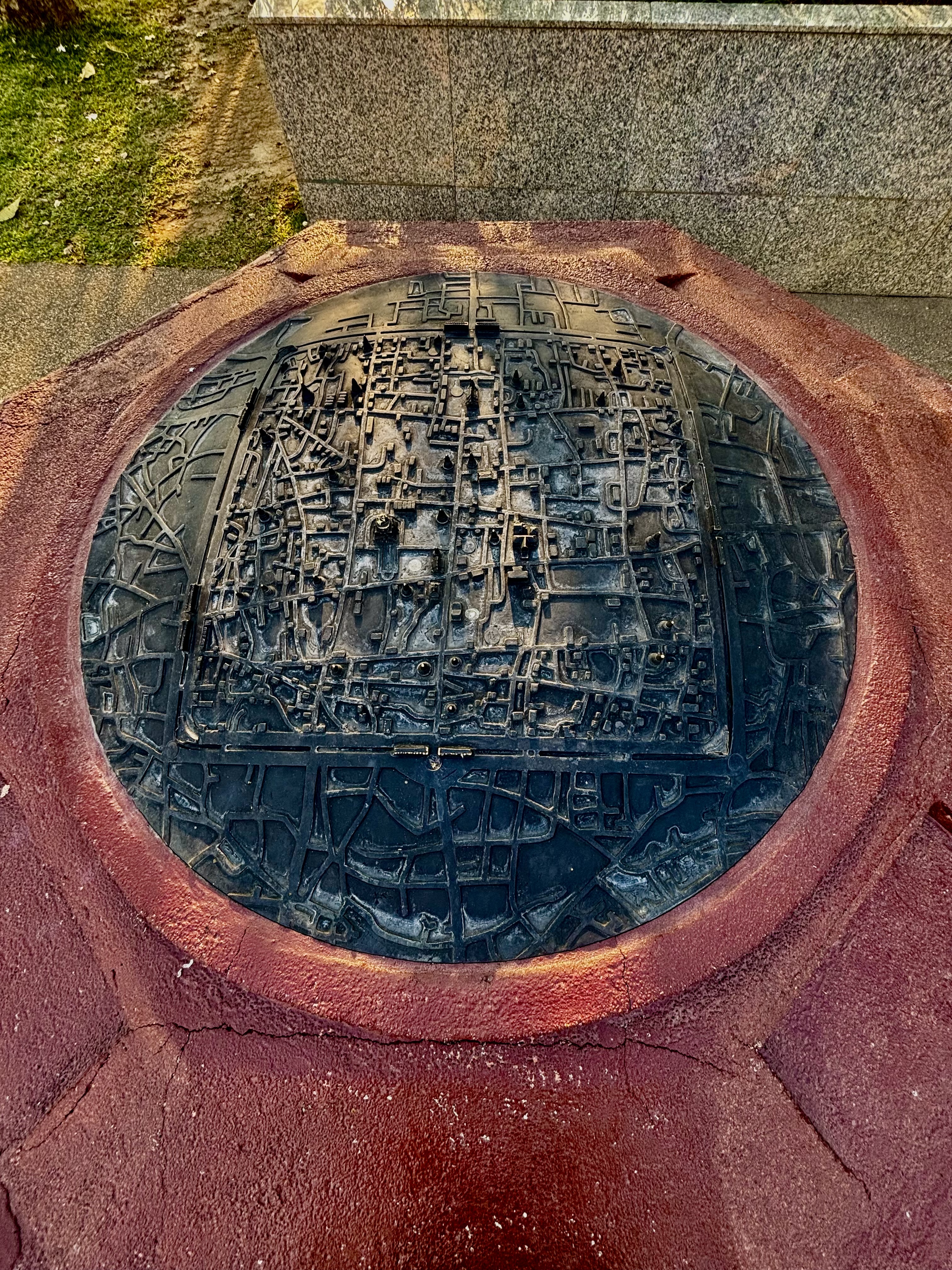
The Three Kings Monument stands on an open public square on Prapokklao Road, in the historic centre of Chiang Mai, Chiang Mai Province, Thailand (Plus Code QXRP+3WX). It sits inside the old city walls, right in front of the Chiang Mai City Arts & Cultural Centre, and is easy to reach on foot from most old-city accommodation.
Landmarks & Attractions Around Three Kings Monument
When visiting the Three Kings Monument, visitors can easily explore the surrounding historical landmarks and points of interest on foot, including Wat Chedi Luang and Wat Phra Singh.
Behind the monument
Chiang Mai City Arts & Cultural Centre
Directly behind the statues in the former provincial hall — Lanna art, history and rotating exhibitions.
≈600 m walk
Wat Chedi Luang
A landmark temple with a massive ancient chedi, a few minutes to the south-east of the square.
≈750 m walk
Wat Phra Singh
Home of the revered Phra Singh Buddha image, west along Ratchadamnoen Road.
Near the square
Sunday Walking Street
Every Sunday from 16:00, Ratchadamnoen Road closes to traffic and becomes a pedestrian night market running from Tha Phae Gate toward Wat Phra Singh. The Three Kings Square sits near its upper (northern) end, about a 2-minute walk from the monument.
Chiang Mai's year runs as a cool, a hot and a wet season, with a smoke season layered on top. Climate, moat water and city wildlife move together — this table puts them side by side so you can choose your window.
Quarter & season
Weather
Moat water conditions
Urban wildlife & greenery
Visit strategy
Q1 · Cool season into early heatJan – Mar
Dry and clear. Nights 14–18 °C, days 28–33 °C, climbing towards 36 °C in late March. Humidity is at its lowest and skies are the clearest of the year; smoke haze builds from February as the burning season starts.
Moat at its annual low: still, slow-moving water with exposed banks and silt along the inner kerb.
Wintering birds still work the moat; deciduous roadside trees drop their leaves; squirrels are most active in the early morning.
January and February are the best walking months of the year. From March, move outings to 06:00–09:00 and check the air-quality index before leaving.
Q2 · Hot season into the monsoonApr – Jun
The hottest stretch: 22–38 °C, peaking in April when readings can pass 40 °C. April is also the worst of the smoke season. From late May the monsoon breaks with heavy afternoon downpours.
The moat recovers from its low point as the rains arrive; the first storms turn the water turbid and fast-moving for a day or two.
Bare branches green up within weeks of the first rains; frogs and insects become loud at dusk and the moat turns into a busy urban habitat corridor.
Avoid 11:00–15:00 entirely. During Songkran in mid-April the square fills with water-fighting crowds and traffic is restricted — expect to get wet and keep electronics sealed.
Q3 · High rainy seasonJul – Sep
24–33 °C with high humidity. Short, intense convectional downpours most afternoons; September is the wettest month of the year.
Moat at its highest level, doing its original job as the old city's drainage and storage system; water runs fast and looks muddy straight after a storm.
The greenest quarter: mature trees in full leaf, dragonflies and water birds along the moat, frogs calling after every shower.
Plan around mornings, carry light rain gear, and stay clear of the moat edge and large old trees during storms. Never wade into the moat.
Q4 · End of rains into cool seasonOct – Dec
October still delivers showers, then the air dries and cools sharply from November. December mornings can drop to 14 °C, giving the coolest and clearest skies of the year.
Moat level falls back and the water gradually clears again through the cool season.
Wintering birds return to the moat and the square's trees fill with sparrows and pigeons; night temperatures drop enough to want a jacket.
November and December are the pick of the year for long walks and photography. Loy Krathong in November draws large evening crowds around the water.
How to read this table
Seasonal ranges are 30-year climate averages from the Thai Meteorological Department; water-level and urban-ecology notes follow Chiang Mai Municipality and the Pollution Control Department. These are typical patterns, not forecasts.
— 07 · Routes & Rhythm —
Routes by Visitor Type
Three ready-made ways around the square, chosen by who is travelling with you and how much walking the group can comfortably take. All of them start and finish at the monument.
Choose your group
Families with children
The short, shaded loop
2 – 2.5 hours · about 1 kmSlow, with sitting breaks
1 Start at the square while it is still cool — children can use the open paving while you explain who the three kings were.
2 Step into the cultural centre behind the statues: air-conditioned galleries, indoor toilets and a short exhibition you can leave at any time.
3 Walk the shaded north side towards the inner-moat lane for a water and birdwatching stop, keeping children away from the kerb.
4 Finish with a drink and a toilet stop before the midday heat, or come back after 17:00 when local families take over the square.
Keep the loop short, carry water and hats, and treat the square as an open-air classroom rather than a fairground.
Photography & nature
The light-chasing route
3 – 4 hours · about 2.5 kmFlexible, driven by the light
1 Arrive before sunrise for blue hour and the first soft light on the bronze — the square is quiet and empty.
2 Shoot from the south-east corner for backlight, then move to the west face for a neutral, evenly lit frame.
3 Follow the inner-moat lane for reflections, dragonflies and the old trees that frame the water.
4 Return at dusk: the statues are floodlit after dark and long exposures work well from a low tripod position.
Direct midday sun flattens the bronze. The two best windows are 06:00–08:00 and 17:00–19:00. Ask before photographing people close up.
Low mobility & wheelchair users
The step-free visit
1 – 1.5 hours · about 400 mFlat, step-free, with seated breaks
1 Arrange a vehicle drop-off on the Prapokklao Road edge of the square — the paving is level and there is no step up to the statues.
2 Circle the monument on the flat inner path at your own pace; the statue bases are visible from a seated height.
3 Use the step-free entrance, lifts and accessible toilets of the cultural centre directly behind the square during opening hours.
4 Avoid Sunday after 16:00, when market stalls block the flat routes and the square becomes congested.
The square is the most accessible spot in the old city; the surrounding temples have steps, so treat them as optional add-ons.
Recommended general routes
Two straightforward itineraries if you have no particular preference — one for half a day, one for a full day, both entirely on foot.
Half day
About 4 hours · on foot
The monument plus the three classic old-city stops around it.
07:00Three Kings Monument squareQuiet light, empty paving and the best photographs of the day.
07:45City arts and cultural centreDirectly behind the statues: Lanna history, cool air and toilets.
09:00Wat Chedi LuangA few minutes south-east — the vast ruined chedi and the city pillar shrine.
10:30Wat Phra SinghWest along Ratchadamnoen Road for classic Lanna temple architecture.
11:30Old-city eating areaAny of the local restaurants and food stalls within a 10-minute walk, then out of the heat.
Full day
About 8 hours · on foot, with a midday break
The monument, the temple core, the moat and the market district.
07:00Three Kings Monument squareStart while the square is still cool and empty.
08:00Lanna museums and cultural centreTwo small museums plus the cultural centre fill the morning.
10:30Wat Chedi Luang and the city pillarThe spiritual centre of the old city.
12:30Lunch and siestaEat in the old-city block and wait out the hottest two hours indoors.
15:00Wat Phra Singh and the west lanesCooler light and much quieter streets.
16:30Moat walk to the east gateFollow the water to the Tha Phae area for late-afternoon light.
18:00Evening market districtStreet food, or the Sunday walking street if it is Sunday.
20:00Back at the monumentThe statues are floodlit and the square is at its most atmospheric.
— 04 · Visitor Guide —
Three Kings Monument Visitor Guide
Key information to plan your visit to the monument in the heart of Chiang Mai's old city.
⚠️ Etiquette & Dress
Although it is an open public square, locals revere the monument as the spiritual heart of the city. Please dress modestly, do not climb or sit on the base, and avoid mimicking the kings' poses for photos. During festivals, devotees offer marigold garlands (Phuang Malai), candles and even red soda — symbols of vitality and respect.
🎧 Free Audio Guide
A 3-minute narrated introduction to the Pact of the Three Kings and the founding of Chiang Mai.
▶Narration in production — check back soon.
Cultural Calendar
Apr 13–15
Songkran Festival
Thai New Year water festival; the square hosts ceremonies and merit-making.
May–Jun
Inthakin (City Pillar) Festival
Annual rites at the city pillar; devotees pray for the city's wellbeing.
Nov (full moon)
Loy Krathong
Floating lanterns and beauty pageants light up the old city.
Every Sunday 16:00–22:00
Sunday Walking Street
The square transforms into a pedestrian market.
01
Opening Hours
Open 24 hours a day
Best time to visitEarly morning (06:00–08:00) & dusk (16:00–18:00)
Sunday Walking StreetEvery Sunday 16:00–22:00
02
Fees
Admission
Free — the monument is open to the public at no charge
How to get there
In the old-city centre, walkable from most accommodation
Photography
General photography allowed, but please stay respectful near the statues
03
Getting There
Red Songthaew (shared taxi)
Chiang Mai's red songthaews pass through the old city; ask the driver to drop you at 'Three Kings Monument'
Tuk-tuk / Taxi
Tuk-tuks and yellow taxis operate around the city; fares are negotiable
Bicycle / Walking
The old city is great on foot or by bike; the monument is near Wat Phra Singh and Wat Chedi Luang
From Chiang Mai Airport
About 30 minutes by taxi or shuttle from Chiang Mai International Airport
Suggested Itineraries
Old City Day Trip
Start at the Three Kings Monument, walk to Wat Phra Singh and Wat Chedi Luang, then end at the Sunday Walking Street.
Lanna Heritage Route
Visit the monument and City Arts & Cultural Centre in the morning, then explore museums and key temples around the old city in the afternoon.
📸 Photo Tips
Morning & Evening Light
Soft morning and sunset light add depth and warmth to the bronze
Square Panorama
Step back to the centre of the square to frame the monument with the old city behind
Frequently Asked Questions
Is there an entrance fee for the Three Kings Monument? +
No — it is free. The monument stands in an open public plaza with no ticket office and no gate, and it can be visited around the clock.
What are the opening hours? +
The plaza is open 24 hours a day, every day. Early morning (06:00–08:00) and late afternoon are the most comfortable times to visit.
Where is it, and what are the exact coordinates? +
On Prapokklao Road inside the old city, Tambon Si Phum, Mueang Chiang Mai District, Chiang Mai 50200, Thailand. Plus Code QXRP+3WX · Chiang Mai; coordinates 18.7902° N, 98.9874° E — accurate enough to paste straight into a maps app.
Which three kings does the monument show? +
King Mengrai of Lanna, King Ramkhamhaeng of Sukhothai and King Ngam Muang of Phayao. The statue group commemorates the alliance behind the founding of Chiang Mai in 1296.
Were the three kings allies? +
Yes. The chronicles describe a pact of friendship between Mengrai, Ramkhamhaeng and Ngam Muang; the monument celebrates that alliance and the founding of the city.
How do I get there? +
It is in the old-city centre, easily reached on foot from most old-city guesthouses or by red songthaew.
Which landmark is closest, and how far is Wat Phra Singh? +
The Chiang Mai City Arts & Cultural Centre is directly behind the statue, about a minute on foot. Wat Chedi Luang is about 600 m away and Wat Phra Singh about 750 m — both a short walk.
What etiquette should I observe? +
Please dress modestly and behave respectfully near the statues, especially when taking photos.
What happens on Sunday evening? +
From about 16:00 every Sunday, Ratchadamnoen Road — which begins near the square and runs toward Wat Phra Singh — closes to traffic and becomes the Sunday Walking Street market. The monument is at the northern edge of the route, so it is an easy place to start or end your walk.
What is available around the square, described by type of service rather than by name. Times are walking times from the monument.
The Three Kings Monument is an open public square and has no dedicated visitor facilities of its own. This section lists the types of service you will find nearby. As a non-profit educational guide we do not name, rank or endorse individual businesses, and nothing here is paid placement.
Toilets
0 – 5 min
Public / venue
The square itself has no permanent public toilet. Usable facilities are inside the public cultural venues facing the square during their opening hours, while businesses around the edge normally reserve theirs for customers. Plan ahead in the early morning and late at night.
Parking
0 – 10 min
On-street / commercial
There is no large dedicated car park at the square. Expect marked on-street bays along the surrounding inner-city lanes and small commercial car parks nearby. On Sundays from 16:00 the streets become a walking street and vehicles are barred — park outside the moat ring and walk in.
Food & drink
2 – 15 min
Restaurants / stalls / cafés
The old-city block is the main eating district: northern Thai kitchens, street-food stalls, cafés and bakeries, plus vegetarian and halal-friendly options. Prices run from street-stall to full-service. Sunday evenings add temporary market stalls right beside the square.
Accommodation
1 – 15 min
Hotels / guesthouses / hostels
Inside the moat the area is dominated by small boutique hotels, guesthouses, hostels and serviced apartments along the main inner roads. Rooms facing the square are the closest you can stay to the monument.
Shops & supplies
2 – 10 min
Convenience / supermarket / pharmacy
Round-the-clock convenience stores, small supermarkets and pharmacies, plus traditional fresh markets and weekend markets. Bottled water, sun protection, rain gear and basic medicines are all easy to find.
Fuel & charging
10 – 20 min
Fuel station / EV charger
There are no petrol stations inside the old city; the nearest sit on the ring roads and main arteries just outside the moat, usually with a shop and toilets. Electric-vehicle charging points cluster at commercial and public car parks outside the moat rather than in the old town.
Cash & connectivity
2 – 10 min
Bank / ATM / mobile data
Banks and ATMs are within a short walk for cash withdrawals. Cards and QR payment are widely accepted in malls and chain stores, while street stalls generally prefer cash. Mobile data coverage across the old city is good.
Accessibility & baby care
0 – 5 min
Step-free / family room
The square is flat, hard-paved and step-free, so wheelchairs and strollers can circle the monument. Step-free entrances, lifts and baby-changing rooms exist in the public cultural venues and larger commercial buildings facing the square, during their opening hours.
Drinking water & heat relief
0 – 10 min
Drinking water / shade
Public drinking fountains are rare in Thai cities; buy bottled water from convenience stores or carry a bottle and ask to refill at a venue. Shade is limited in the middle of the square, so use the tree-lined edges and the indoor venues at midday.
Health & emergency
5 – 15 min
Clinic / pharmacy / emergency
Clinics and pharmacies are within the old-city block. Emergency numbers: 191 police, 1669 ambulance and rescue, 1155 Tourist Police. The square is well lit at night, but keep an eye on your belongings in crowds.
Emergency contacts
Tourist Police (English spoken)
1155
Police
191
Ambulance & rescue
1669
Tourism Authority of Thailand call centre
1672
— 05 · Cultural Triangle —
Three Kings Square Cultural Triangle
Behind the monument sits Chiang Mai's most important museum cluster — plan to explore them together.
Behind the monument
Chiang Mai City Arts & Cultural Centre
Immediately behind the statue — exhibitions on Lanna art, history and rotating shows.
Across the square
Lanna Folklife Museum
Directly across the square — traditional Lanna crafts, textiles and daily-life exhibits.
A few minutes' walk
Chiang Mai Historical Centre
A short walk away — models and archives tracing the city's 700-year history.
Tip: a combined ticket covers several of the museums — budget 1–2 hours for a self-guided cultural walk around the square.
“The Three Kings Monument is both the starting point of the old-city tour and a favourite gathering place for locals.”
— 12 · Stewardship —
Understanding the Place & Your Part in It
A short reading of what this square actually represents, and what visitors can do — or avoid — to keep it in good shape for the city that uses it every day.
Why this square matters beyond the statues
The square is a working civic space, not a fenced exhibit. Residents use it for merit-making, morning exercise, school outings, graduations and evening gatherings, so its value to the city is social as much as historical.
The monument marks the origin story of a city founded in 1296 as the capital of Lanna, and it anchors a cultural cluster: the former provincial hall, the Lanna museums, the city pillar shrine and the two great temples all sit within a few hundred metres.
The moat that rings the old city is an engineered hydraulic system, not decoration. It still manages stormwater, which is why it rises fast in the rainy season and turns turbid after heavy storms.
The old-city tree canopy is heritage infrastructure in its own right: mature rain trees and flame trees shade the square, host urban birds and reduce the heat-island effect of the surrounding paving.
Editorial policy
This site is an independent, non-profit educational project about a single public monument. We publish no advertising and accept no payment for mentions; we do not name or rank surrounding businesses; historical statements are attributed to the published sources listed in the references section, and legends are labelled as legends. The information here is general guidance only and does not replace official notices from the Thai authorities.
Visitor responsibility
Cultural respect
—
Do not climb on, lean against or sit on the statue bases — they are memorials, not furniture.
—
Cover shoulders and knees when you enter the temples and cultural venues around the square.
—
Never point your feet at the statues or at anyone sitting on the ground, and keep voices and music down at the memorial.
—
If you want a photo with the statues, take it standing. Posing as if on horseback or mimicking the royal gesture is considered disrespectful.
Environment & public health
—
Do not feed the pigeons, sparrows or any other urban animal. Feeding concentrates birds, damages paving and monuments with droppings, and spreads disease to both people and animals.
—
Do not release fish, turtles or other animals into the moat — introduced species displace the aquatic life already there.
—
Use the bins provided and separate your waste; litter blown into the moat is expensive to remove.
—
Do not pick flowers, break branches or take cuttings from the old-city trees, and never wade, swim or fish in the moat.
Your own safety
—
Drink water before you feel thirsty and stay out of direct sun at midday — heat exhaustion is the most common visitor problem here.
—
Wet polished stone and metal become very slippery in the rainy season, and storms drop branches, so keep clear of the moat edge and large old trees during heavy rain.
—
Watch your belongings in the Sunday market crowds and keep bags zipped in front of you.
—
Call 1155 (Tourist Police) or 1669 (rescue) if you need help — both are free.
— 06 · Gallery —
Three Kings Monument Gallery
A photographic collection of the Three Kings Monument in Chiang Mai's old city.
The bronze monument stands in an open square in front of the City Arts & Cultural Centre.
Photos used for non-profit educational purposes.
Image rights: all images displayed on this website remain the property and copyright of their original photographers.
Historical facts, coordinates, opening hours and the rating on this page are compiled from the reliable sources below, to support the page's expertise, authoritativeness and trustworthiness (E-E-A-T).